About a month after I arrived in Nigeria as a construction project manager, a military coup broke out, and the army took control of the government with the full support of the citizens, who had grown tired of the corrupt political regime. As usual, it was a colonels’ coup: they became state governors and appointed Muhammadu Buhari as head of state.
The army declared war on corruption, which brought smiles to the faces of the locals—already used to such situations—knowing that in Nigeria, “only the sky is the limit for corruption.”
While I was working on constructing a building for a particle accelerator at Ife University, I was called to the company’s main office for a meeting with the company’s director in Nigeria.
“Look,” he said, “we’re in trouble, and we think only you might be able to get us out of it.”
The head of state wants to show that he can move projects forward in a way never seen before. He chose, among others, a project we started and then stopped because the client ran out of funds. The project is a commercial center near the entrance to the University of Ibadan. It’s far from finished, but we’ve been given three weeks to complete it. All of the company’s resources are at your disposal, but you’ll be on your own—we’re not involved.
I went immediately to the site and realized that I had passed by it many times without noticing it, as the bush had grown up around the buildings and hidden them from view.
I called two foremen I knew from other projects and asked their opinion. They laughed at me, not believing I had gotten myself into this mess—and worse, was inviting them in too. I calmed them down and told them I had an idea they’d be glad to be part of.
Here my experience as a naval officer came in handy. A camouflage exercise the likes of which Buhari had never seen.
A Potemkin village (look it up on Google) in the middle of Ibadan.
I devised a tour route and decided to complete—visually—only the works along that route.
We uprooted the bushes and trees and cleared the area. I brought in quarry material and spread it around. We painted the buildings from the outside and installed an elevator car in the shaft without connecting anything. If he wanted to go up? He’d have to exit the elevator and take the stairs. We poured concrete surfaces according to the plans and built gates with short fence sections on both sides (like in the film Blazing Saddles, for those who remember). I recall a situation where the surveyor couldn’t find the corner of the lot to mark the road that was part of the university entrance junction. I took a stake, look ed at the plans, eyeballed a direction to the right and left, planted the stake, and said, “Here’s the corner.”
The state governor was brought into the loop because his neck was also on the chopping block. At first, he didn’t believe we could finish what we had set out to do, but in the days that followed, as he saw how much we accomplished in so little time, he began to feel better about the plan.
And so, one day before the “opening ceremony,” the company director arrived wearing swim trunks and flip-flops so no one would recognize him—to see if he could attend the ceremony or if he should flee. He became convinced there was a chance to come out of it with dignity and invited me to the event.
The next day, tents were set up on the site for the local kings, each with his entourage of servants and entertainers, and the locals took control of the situation—to everyone’s delight.
The head of state arrived and was led through the route by the governor, with me trailing behind, ready for anything. Everything went smoothly, and in his speech, we received praise for completing the commercial center for the benefit of the people.
My foremen and I received bonuses for saving the company.
It took at least another six months to actually finish the project.
Buhari is the current president of Nigeria. The country returned to civilian rule a few years after the event, with its first president being Ibrahim Babangida—the senior officer who orchestrated the coup behind the colonels’ backs.

Opening ceremony and the guests

The head of state Muhammadu Buhari (in uniforms)
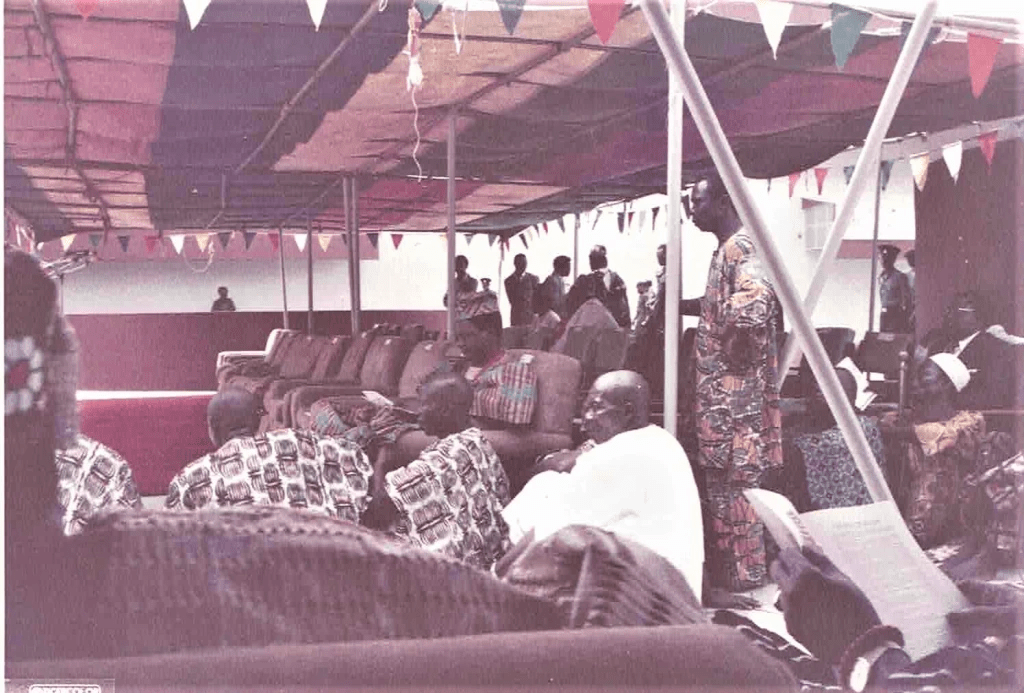
A local King and his servants

The entrance to the shopping center across from the entrance to the University of Ibadan
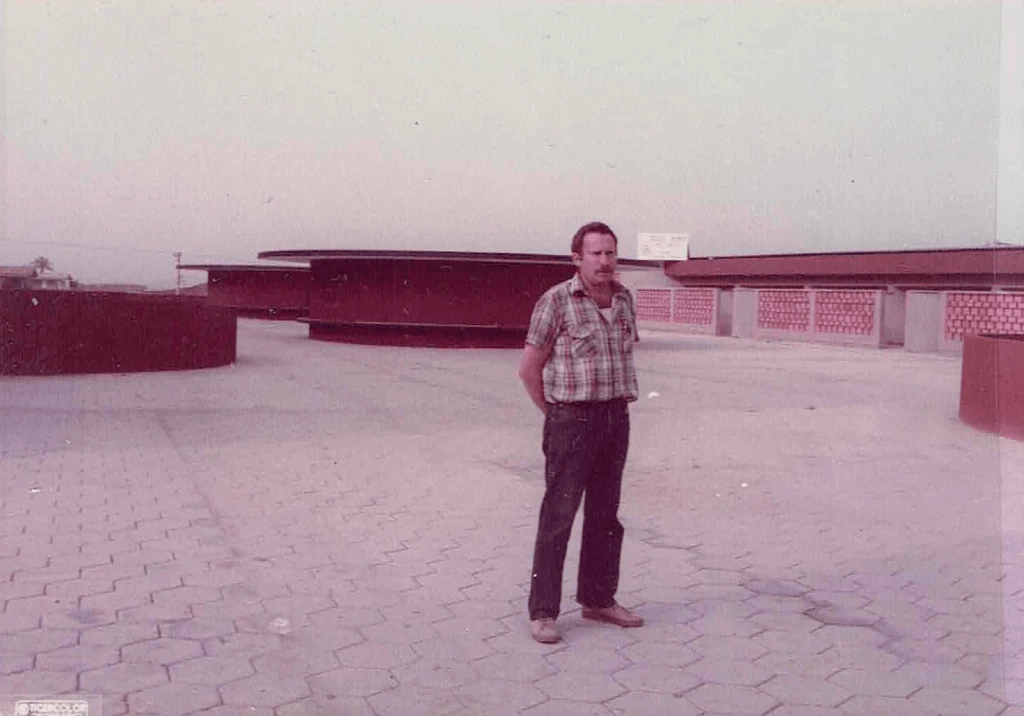
“Those were the days, my friend”
 Yackov's English Stories
Leave a comment