The experiences described in this post are those of a teenager who had no prior maritime experience.
Around September 1968, after tests and exams, a group of candidates for the naval officers course had formed at the Bakum (IDF Recruitment Base). One day, we were loaded onto a truck with benches along its length, headed to BN”H (Haifa Naval Base) for an admission interview to the course. (Yes, BN”H, before B”H and before the Northern Command HQ. The HQ was in Stella Maris, so the port had a port commander. The sea is the same sea, just now it’s called a “naval arena.”)
We arrived at a base that looked quite neglected. We sat and waited for our turn on a small concrete platform under a two-story office building that stood on the breakwater. Above us was a balcony facing the port, providing some shade from the sun and the heat in the area.
During that time, we had a chance to observe the naval vessels in the port and the soldiers moving about like ants on the breakwater and piers, securing the vessels. We clearly saw a destroyer (INS Yaffo), which was very active, and next to it an older one (INS Haifa), apparently nearing the end of its service. There were a few torpedo boats, and the T-206 looked relatively good. On the new piers, we also saw a small number of new missile boats being outfitted and prepared for routine operations. Next to the Yaffo stood an old submarine, Tanin, which added a WWII-style military flavor to the overall picture.
More than anything, I remember how the soldiers looked. They were muscular and rather scruffy. Most were missing teeth, and overall, they seemed very different from the people I knew in my childhood in Ness Ziona—much rougher.
As we sat and waited, some kind of commotion began around us, like a fire catching in a dry grass field—starting slow, then suddenly picking up pace. Suddenly, right above our heads, a soldier flew through the air. He had performed an impressive jackknife dive from the balcony of the office above us into the filthy port waters. Military police chased after him to the railing but didn’t dare jump after him. The pursuit continued along the piers as the soldier swam toward the civilian port. A beastly-looking officer or sergeant major ran down the pier and right into the water, uniform hat and wallet still on him. With impressive swimming, he closed in on the fleeing soldier (I thought, “Wow, a commando!”), caught him, and dragged him back to the pier. Both climbed out, soaked, the soldier was handcuffed and taken away in a military police jeep. Needless to say, this soldier was also missing teeth.
This event made a huge impression on me. I remembered my literature teacher who tried to develop the idea that nature arranges things so that every person ends up in their rightful place. She even gave the example that, by nature, sailors on ships are people who can’t quite integrate into regular society—inhabitants of the bilge (the space under the ship’s floor). And here it was, like a movie unfolding before my eyes. I asked myself: am I volunteering to live in this bilge?
After that, I wasn’t afraid of the interview anymore. I looked up to the sky and said to myself, “My fate is in His hands.”
In the room sat high-ranking officers, judging by the amount of gold insignia on their shoulders. They asked personal questions until I got stuck on one that I assume they ask everyone:
“A fire breaks out on a ship. There’s no electricity, and no water pumps. You’re the commander. What do you do?”
The answer that was on the tip of my tongue was: a jackknife dive from the deck into the sea. I knew that would throw them off balance, so instead, I answered meekly: Buckets! A bucket chain.
And I was accepted to move on.
During cadet voyages on the INS Yaffo and the old Noga, I feared for my life. I was never a tough guy, and all around me were toothless soldiers who terrified the young cadets, who moved about like floaters on the moon, clueless. The Yaffo was a large ship with ladders and stairs everywhere and many dark rooms. The steering wheel was placed in a dark, windowless room, and the helmsman received orders via a gleaming brass pipe system. The helmsman had no idea if the ship was sailing on the sea or on the moon.
On the ship, there were many sergeant majors who didn’t move around much. They gathered around a Rummikub table laid out on a thorny blanket, after battle stations and communication drills. They ran the ship from that table, using messengers standing beside them to relay orders. In battle stations and damage control, they showed their professionalism—until the next time. I was afraid of them, of the messengers, and basically of everyone—except the sea. The enemy wasn’t a concern. I thought, I’m already in hell, what more could the enemy possibly do to me?
Buckets of water reminded me of an event many years later, in Be’er Sheva. In the middle of the night, a neighbor knocked on our door asking for help to put out a fire in her apartment. I ran out immediately and climbed the stairs, holding up my pajama pants with one hand because the elastic had worn out.
The apartment was filled with thick smoke from a small burning plastic TV, and the electric lights couldn’t even shine through it. I went in to assess the situation, came back out, and asked for a bucket of water. So, with a bucket in one hand and pajama pants in the other, I stepped into the darkness toward the fire’s center. I poured the water and put out most of the flames. Then I asked for another bucket and went in to finish the job. I opened windows to let the smoke out. The neighbors were all standing outside, and no one dared go in. The neighbor from across the hall (the granddaughter of Naftali Herz Imber) stuck her head out and asked about the noise. When we said “fire,” she asked if we had called the fire department.
In my mind came the thought: Contrary to Ruti the literature teacher’s theory, here’s proof—a sailor can indeed integrate into society, and even be of help.
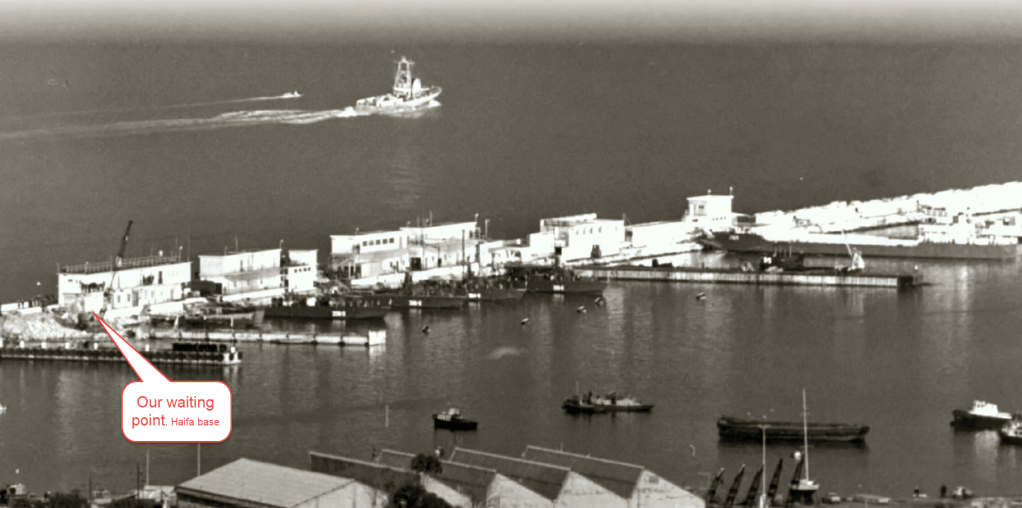
Picture of Haifa base (December 1967)
 Yackov's English Stories
Leave a comment