We eagerly awaited the diving course. The sense of closeness to commando activity gave us the feeling of “we’re among the heroes too.”
We arrived at the course after a very precisely run parachuting course. One instructor could switch with another mid-sentence and continue the explanation as if nothing had happened. It seemed as if they were all cloned from some legendary instructor who had parachuted Hanna Senesh.
The base was tidy and clean. It was clear the course was managed in a way to prevent accidents due to mishandling of the equipment, while the young paratrooper was still in shock from what was happening around him during the jump. They tried to turn us into automatons.
Already on the walk from the root of the breakwater that served as the base for Unit 707 toward the classroom, we realized this was a different world. The eye caught only disorder. 360 degrees of chaos. Officers and soldiers in Speedos with bits of military uniform wandered between scattered buildings that looked like they had survived an aerial bombing. Rusty iron rods jutted out from the ground or from chunks of concrete scattered all over. Armored personnel carriers, junior officers, and a rusted ship tied to the dock added to the background and set the stage for the film playing before our eyes. It seemed the base’s inhabitants had gotten used to this view and didn’t see anything wrong with it.
Some people feel cool amidst the dysfunction.
We were taken to a corner on the pier facing Shemen Beach, stripped down to swimwear. Good thing no one filmed the event — we looked pale, and the swimwear we received was far from stylish, more like underwear from the surplus of the Polish army.
Plastic plates were thrown into the water, and we had to free-dive and retrieve as many as we could. I think the exercise was meant to see how we felt in the water, since afterward, the pairs were set based on friendships, not results.
Everyone jumped one by one, diving with masks but no fins, in rather murky water. Some retrieved one plate, some more, and some none. Not everyone grew up practicing dives in puddles in their neighborhood. Some bragged, some were scared, and some just stayed quiet.
I took it as a matter of pride — someone from Ness Ziona who, until the draft, had only seen Bat Yam Beach on summer Saturdays.
I realized I wouldn’t have enough air to stay above each plate, so I planned a dive path that passed between the scattered plates to allow me to grab them with both outstretched hands. I dove and started collecting right away, reaching out in all directions. My lungs began to feel the pressure, but there were still two plates left. I began exhaling as I moved toward them. I decided to dive deeper and pick them up on the way back up. I grabbed both with the tips of my fingers and surfaced, out of air, to inhale fresh air above the dirty water. I felt good and earned a few pats on the back.
In the course, I dived with my good friend Rahamim Nachmias (Naor), who, as far as I remember, maybe picked up a plate and a fork.
The course progressed slowly. We learned to dive and feel like fish in the water. Some guys were afraid and filled their lungs with air, making it impossible to submerge. For them, they strapped on two weight belts, which sank them like an anchor the moment they touched the water. That scared them even more, and then came cases of ear infections, which helped those guys quit the course.
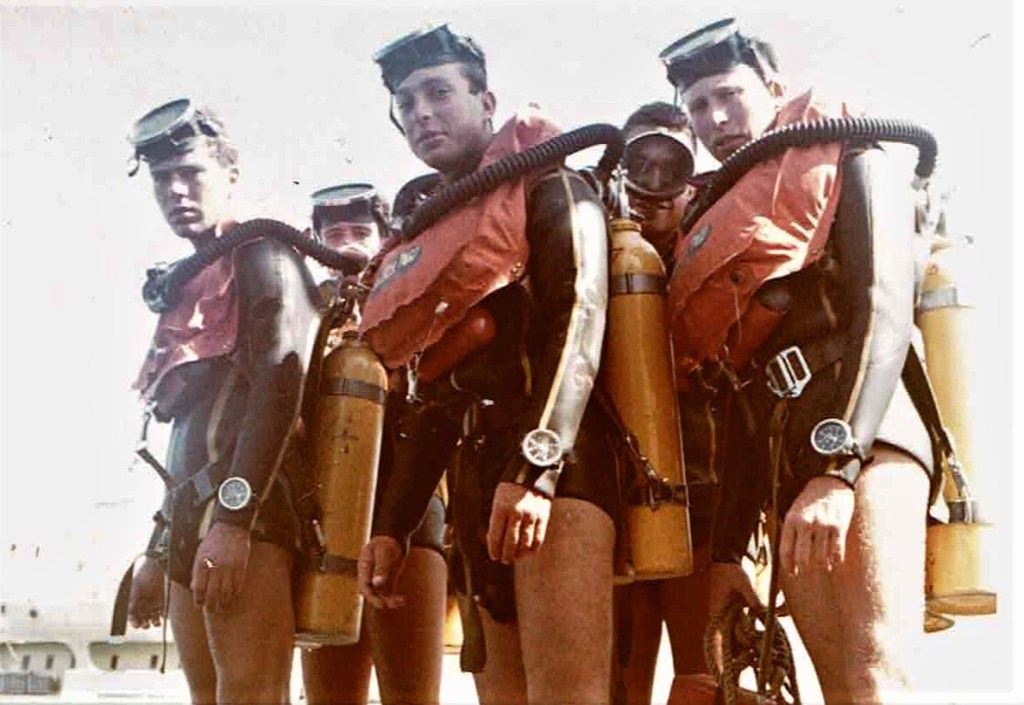
The rest of us trained in equipment exchange underwater and rescue drills conducted in total darkness, during day or night training (due to the water pollution).
I remember all we could see of our partner, within arm’s reach, was the stainless-steel band of their mask.
After a 15-minute drill, we had to stay at the bottom of the sludge for another 45 minutes to empty the air from our tanks. We turned on flashlights to see the seabed, but all we saw were large rocks and lots of crabs. Everything was covered in black muck, making the scene boring and quite disgusting. We realized we were standing on crabs and sludge the whole time.
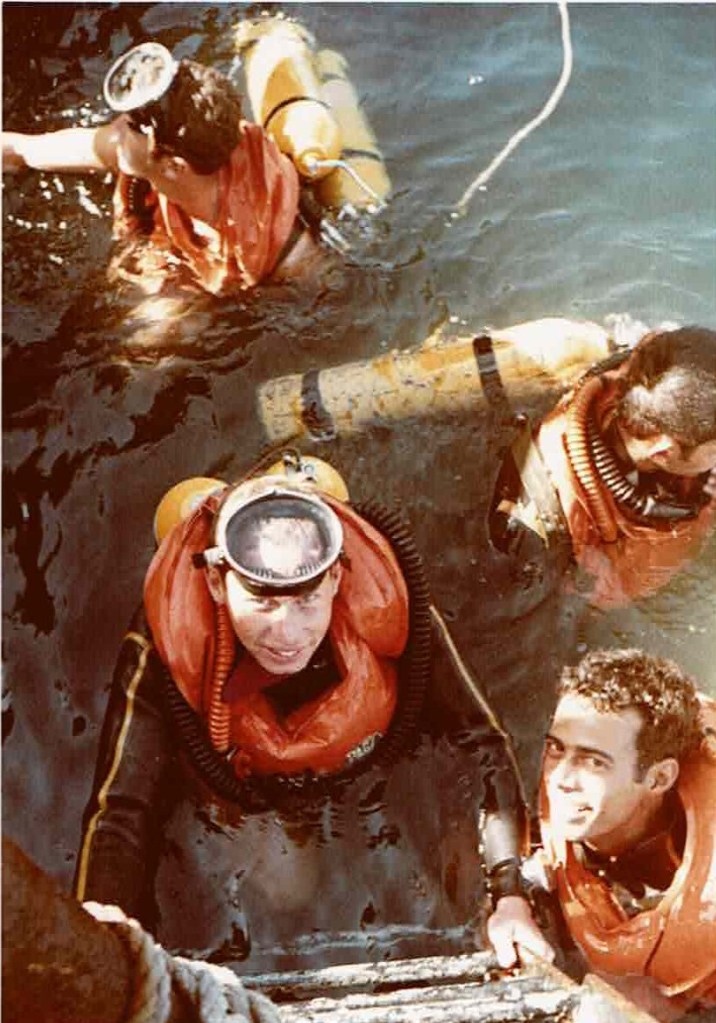
When we felt the air running out, we had to reach for the tank, lower a small lever that gave us enough air to ascend calmly to the surface. From there, we swam to a rusty ladder and struggled to climb onto the dock. The gear was weightless in the water but heavy and bulky on land. There was also shrinkage, as the genius George Costanza said — but we’ll overlook that in this post.
At the end of each day, we returned to the sailor’s house for a shower with “horse soap” to scrub off the oil and grime stuck to our bodies.
The final exercise was a free-dive under the rusted ship tied to the pier — likely the old INS Haifa.
We had to go down on one side and emerge on the other. Sounds simple, but in reality, it was a dive I’ll remember all my life. I took a deep breath and descended along the hull to the bottom. I thought I would need to ascend along the opposite side.
But that wasn’t the case.
The bottom was flat, and we had to dive underneath, perpendicular to the ship’s position. It was dark below, and in the darkness, I lost orientation and probably swam along the length of the ship instead of across it. I ran out of air, images of my family flashed before my eyes, and with one last effort, using my hands on the ship’s underside, I managed — while swimming face-up — to push myself toward a faint patch of light. When my head broke the surface, I realized I made it, I was alive, and I was on the other side. I needed a long time of deep breathing to clear my lungs of the bad air that had built up.
It was a dive with a safety margin close to zero. To this day, I don’t understand (actually, I do) why there wasn’t an instructor under the ship with air tanks and diving gear to save lost souls like me. The instructors took up positions around the ship outside the water to supervise. But if you can’t see the divers, what’s there to supervise?
The sail and dive in the Shikmona reef as a reward for completing the course was short but left us wanting more.
 Yackov's English Stories
Leave a comment