In our Class 18, there were delays in starting the sailing due to ambushes we were involved in to capture Egyptian commandos who had previously sunk the INS Bat Galim. For the mission, a team of Shayetet 13 fighters landed in Eilat on a Nord aircraft. They roamed the beach with their Speedo suits that bent their antennas. To everyone around, they were clearly signaling: “We’re here.”
Apparently, the transmissions were also picked up by enemy forces. All efforts to catch a “fish” with our heroes’ hooks yielded nothing, and the Egyptians only arrived after seeing the Nord plane take off northward. During the attack, a diver was killed while attempting to refloat the Bat Galim.
For the sailing, Zodiac Mark 5 boats were brought, with two 40HP Evinrude outboard motors hanging off the stern shelf.
The mission commander was a naval officer named Yaffe, who also commanded the shore raids we conducted as part of the command training series during the course.
Yaffe was an impressive man, with bat wings on his chest (Shayetet 13 insignia) and a mane of hair, looking like an “Italian actor, straight out of Yugoslavia.” He spoke with a bit of an accent, a rolling “R,” and a thunderous “SH.” That “SH” he got along with a set of dentures that had been installed in his mouth. According to stories we heard, this brave officer had participated in a Navy experiment to parachute fighters with their diving gear. The attempt involved jumping with air tanks strapped to their chests — the result: a “SH” with no teeth.
During the beach raid series, we enjoyed his briefings thanks to his frequent use of the term “the raiders (Poshshshtim) force” (with exaggerated SHs).
On the voyage from Eilat, Yaffe insisted on pronouncing Dahab as “El Kura,” which is actually correct. Maybe it was because of his rolling R, or maybe because of the magical phrase, “Frommm there we’ll sail to El Kurrra,” which brought joy to our trainee hearts.
The departure to sea was in high spirits, symbolizing the end of a tough, physical training series. The voyage was supposed to be a fun one.
Each boat carried heavy equipment — fuel and drinking water jerrycans, of course, plus paddles and other gear lashed onto the boat. The instructors wore Calypso wetsuits that looked like looted suits (they weren’t from Schneiderman), and the trainees wore German life vests (jackets), which at first felt cumbersome but, like most things in life, even in discomfort there is comfort.
The turtle carries its home on its back. Always protected.
The German life vest was like a mattress to the trainee, snug against the body, complete with a blanket.
Because of that, I remember very little from the voyage itself — the memories are veiled in a mist.
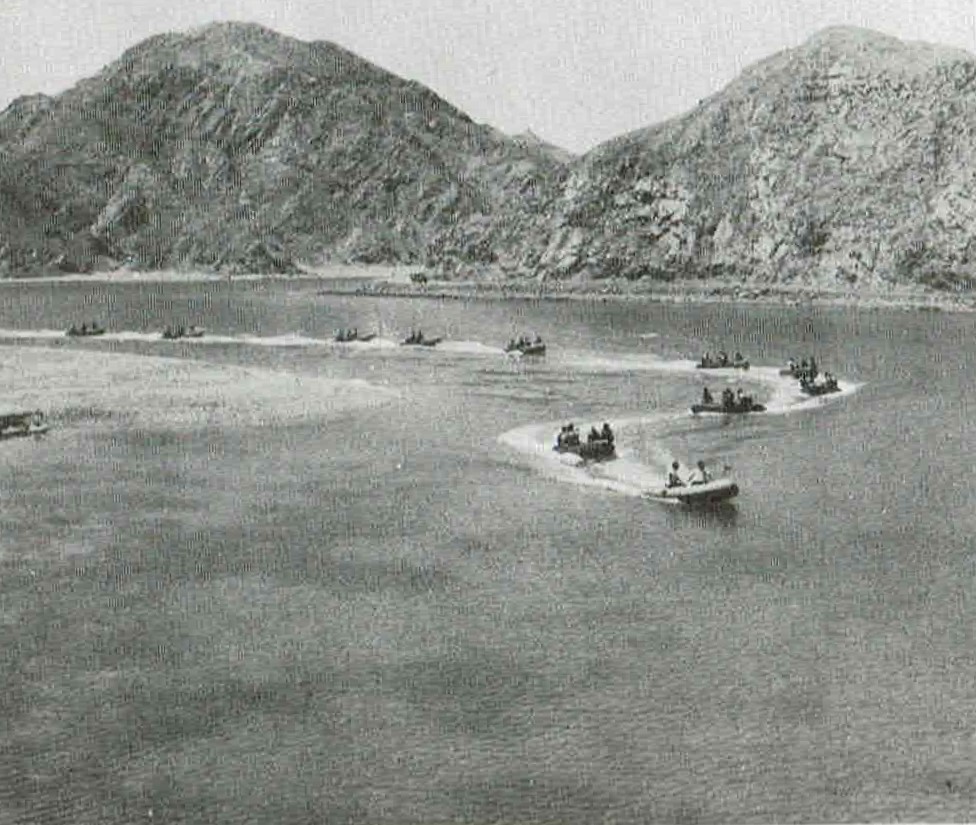
Sailing in the “Fiord”, South of Eilat

Coral Island (Pharaoh’s Island)
We headed south, passed through the fjord and Coral Island (Pharaoh’s Island), and “frommm there we sailed to El Kurrrra.” The outboard motors weren’t aligned with our plans, and every few minutes, another engine would shut down. The convoy would stop, and Avinoam, the bespectacled magician, would move to the distressed boat and fix the motor while the boat was still slowly moving.
The slow pace of the voyage had its effect — that warm, creeping feeling in the body calling you to just surrender to it, lie down and rest. Suddenly — plop — an instructor opened the throttle and a cadet flew into the sea. A quick “Man overboard,” and the trainee was pulled back onto the rubber boat.
An interesting phenomenon solved a childhood mystery for me. In Eddie Constantine movies, he always came out of the water with his hat still on his head. Who remembers that hat? Every trainee who fell in also came out of the water with their cap still on.
The voyage continued with repeated malfunctions, motors bleeding out, cadets flying into the water, dunked and retrieved.
At the El Kura stop, command had apparently had enough of fishing cadets out of the water. A firm order was issued: “Anyone who falls into the water is out of the course.” I don’t remember if we slept there that night or not — whether we slept here or there, who cares at this point?
The stop gave Avinoam a chance to go over all the motors and give them a “blessing for the road” for a more successful continuation.
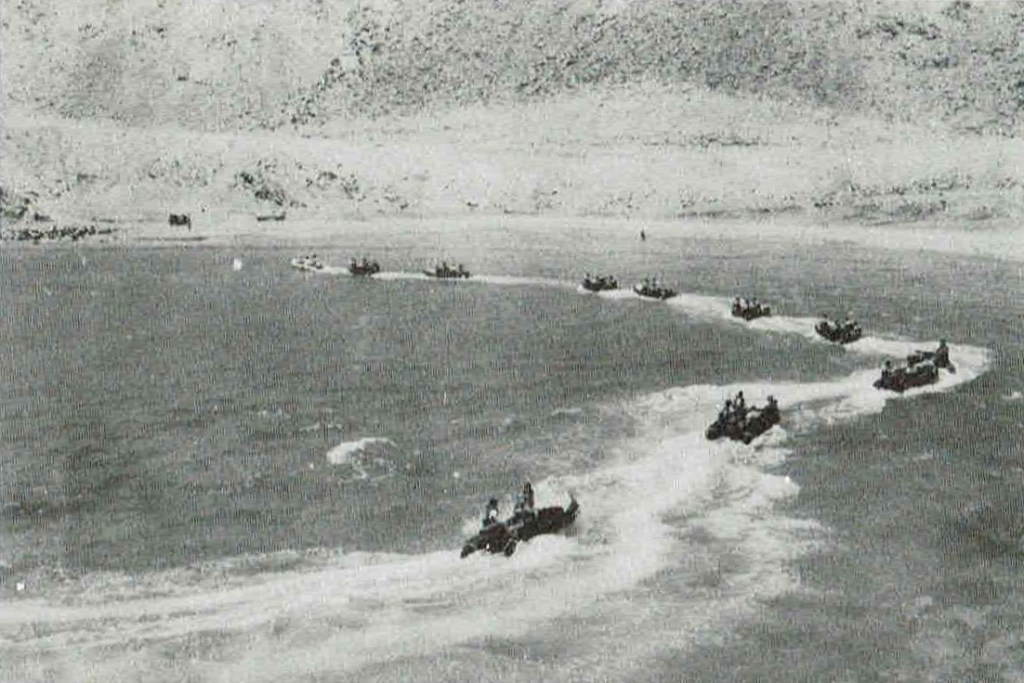
Sailing into El Kura
From the moment we set off again, it became clear we were in Chapter B of a story that had been meticulously copied from Chapter A. The sea was slightly rougher, and waves from the stern occasionally “covered” the outboards. Water and fuel aren’t friends, and something had to give.
Something’s Gotta Give.
The sea doesn’t.
At this point, we were more tired, and especially more bored. For support, we developed techniques for sleeping with a tighter grip, reducing the number of falls — or at least we fell into the boat.
One fall stands out in my memory. Ami Shuler emerged from the water, his cap still on. At first, he had the look of someone who just woke from a “wet” dream into an even wetter reality. His expression turned to sorrow. I felt he wanted to shrink into himself, to disappear. We pulled him out of the water, and since you can’t kick half a course out — the order turned out to be toothless. Thankfully.
The biggest moment came as we neared the Straits of Tiran. A pod of dolphins started playing with us. They jumped alongside, dove under us, and everyone came alive. The sea was calm, the motors kicked in, and we felt an exhilarating sense that yes — we were going to make it to Sharm, and in the company of dolphins, no less.
And then everything changed.
Suddenly, the bottom of one boat tore open and the boat stopped. As we scrambled to assist, the bottom of a second boat tore. We approached the distressed boats and saw a surreal sight — sailors sitting on jerrycans, their legs splashing in the water, plop plop. Around them, like ducks with squeaky toys, floated fuel and water containers — and those same paddles. The looks on everyone’s faces told the story: “Now what?”
Command realized we had run out of sea.
A landing craft (NATK) was called for rescue. It lowered its ramp, we loaded the gear, and set off on an enjoyable sail to the Sharm El Sheikh base.

Yaffe on the bow

 Yackov's English Stories
Leave a comment