
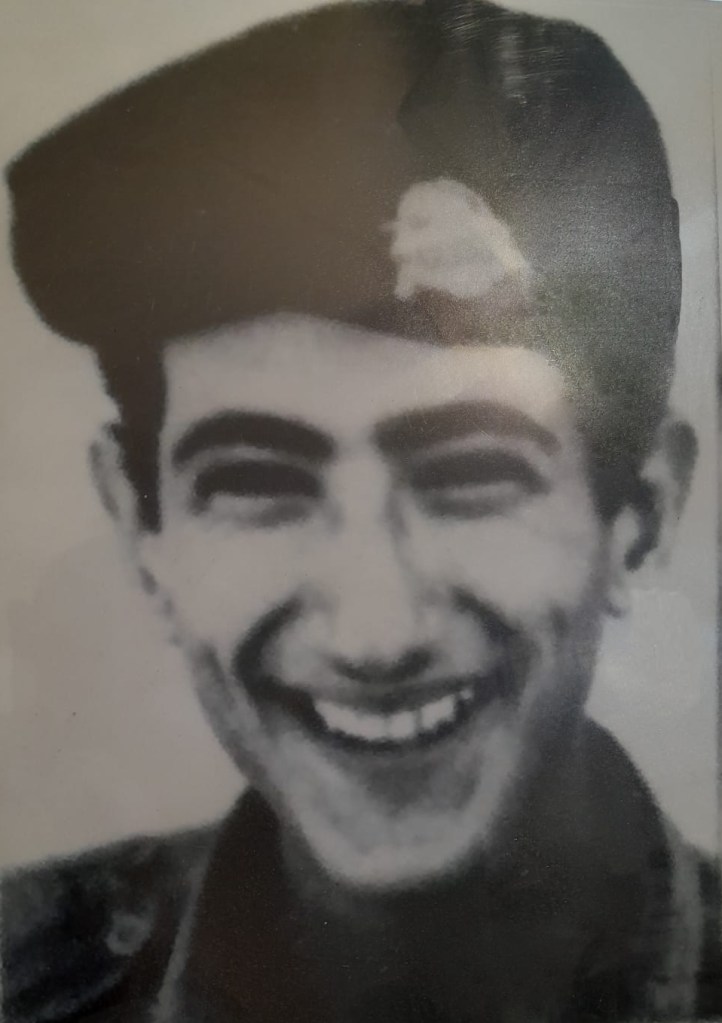
On the occasion of the first jubilee (50th anniversary) of the Yom Kippur War, I wish to remind everyone of a simple soldier who drove a tank to his death in the battles of containment .
I knew Mordechai, may God avenge his blood, or as I heard his father call him—Morduch—a bit from afar. We lived in the same neighborhood in Ness Ziona. A sandy path (Dgania Street) separated the backyard of our house from the front yard of the Sharama family. In that space between the yards, life took shape in the melting pot of Israeli society. The smells of Yemenite and Polish cooking mingled together. Like the scents, the sights and sounds of the residents—each in their own language and tone—blended into one continuous and pleasant melody.
The father of the Sharama family was a rabbi and cantor in the Shabazi Synagogue on Negba Street, and it was clear he was held in high esteem as the Torah reader and cantor who led the entire service. In the traditional procession held every year after the reading of the five scrolls on Simchat Torah, Shalom z”l led the parade, beaming with happiness. He didn’t dance and skip like the others—he simply radiated, emanating honor and reverence for the Torah.
Mordechai was the youngest son in the family. I had the privilege of knowing his sister Yemima z”l, who was in my class, and his older brother Ovadia, who, though a bit older than me, kindly included us younger kids in his activities. I vividly remember his lovely voice and his love for singing. When the Indian movie The Vagabond Starring Raj Kapoor came to town—it became hugely popular thanks to its songs that were played again and again on the radio—Ovadia sang Ichik Dana better than any of us could have imagined.
I came to know Mordechai, who was younger than me, during the weekly preparations he made for reading the Torah portion on Shabbat. His father apparently intended for him to continue the tradition of cantorship and would teach him the weekly portion during the weekdays. The study sessions worked like this: the cantor, who did not hold a book (since he knew the Torah and the cantillation marks by heart), would chant the verse—or part of it—and the son, with a large Torah book open on his knees, would repeat after him. Often, the cantor would not accept any mispronunciation or missed syllable or word, and would correct his son, who then had to repeat the verse or part of it until the reading was as it should be.
These sessions were held in the courtyard, with father and son standing apart, their voices carrying through the air between the neighborhood yards.
I loved the sound of the Yemenite cantillation coming from their voices. Both had soft and gentle voices that suited the sacred texts. I especially loved the end of each session, when the father would sing the learned portion and the son would echo him. In those moments, I felt their voices rising, higher and higher, reaching the ears of the angels above.
As a child, I knew that Torah readers earned a place of honor in the world to come. To this day, I can hear them in my mind: “Vayomer Adonai…” (with the melodic flourish at the end).
I didn’t know much about Mordechai’s early adulthood. I was drafted into the IDF about three years before him and served far from home. The last time I saw him, he was still a young boy, shyly keeping to himself with a bashful smile. He was slender, as if trying not to disturb those around him.
Later, I heard that Mordechai had enlisted in the Armored Corps, even though his body weight was below the minimum required. His courage, love for the land, and care for others pushed him to volunteer and serve nonetheless. Perhaps, as a driver in the cramped tank, his slight build was actually a better fit than the broader soldiers?
The Yom Kippur War found him in Sinai, in the Mitla Pass area, in the battles of containment against the advancing Egyptian enemy. He fought bravely for about five days. On the morning of the fifth day, the holiday of Sukkot, while the people of Israel sat in their sukkahs and hosted the ushpizin (symbolic guests), Morduch sat at the front of the tank in the driver’s seat, at an observation post.
An order came over the radio: Advance and attack!
The tank emerged from its cover and charged forward. A prayer to God rose to his lips, along with a plea—for the well-being of his comrades.
Opposite him stood an Egyptian soldier trained for just one task: to aim and fire a Sagger missile at the enemy tank.
He locked onto the target and pulled the trigger.
“Shema Yisrael!” cried the cantor, and the voices of the congregation repeating after him rang out in the distance like thunder overpowering the roar of battle.
The missile launched and raced toward the tank. No seraph or angel stood in its way to stop its flight.
“Yisrael” did not hear.
Even the merit of a Torah reader could not protect him.
The missile struck its target.
In the divine silence that followed, a massive ring of fire rose slowly into the air—and at its center, his pure soul ascended, floating upward. The fire did not touch it—because it could not.
The two other crew members in the turret survived the fiery trap. The rest remained safe in the hull for the rest of the war.
“And the sun set, and he became clean.”
(Leviticus 22:7, read on Sukkot)
May the memory of Mordechai Sharma be blessed.
 Yackov's English Stories
Leave a comment