About half a year before my planned discharge from the army, I went out with the commander of MarShal (Marhav Shlomo) on a Dabur boat to the Straits of Tiran so he could see them up close. Luckily for me, the commander of the Red Sea area (Mazar) didn’t come along, which gave me the opportunity to talk freely with the commander.
The sea was calm. We sat on the open bridge. To the east, in all its glory, stood Tiran Island, with the mountains of Saudi Arabia in the background. To the west, Ras Nasrani, with the mountains of Sinai sloping down to kiss the coastline. The conversation flowed easily. After the military talk, he asked about my plans for the future. I quietly told him that after completing my service contract, I would be discharged. After that, I planned to head out into the world and make a boochta (a bundle) of money before settling down and getting married to build a home in Israel.
I had two options ahead of me:
(Yelling) T…I…M…B…E…R!
Go to Alaska on a three-year contract to the cold rainforests. Join a logging company, and if I survived the contract, I’d come back with the much-desired boochta.
(Calling out from the masthead) There she blows!
Go to Norway on a three-year contract to work on a ship in the North Sea, hunting whales. Again, if I survived the contract, I’d return with a handsome boochta in my pocket and be ready to start a family and build a home.
A wide smile spread across his face, and his eyes showed astonishment. Sitting in front of me was a confused and puzzled colonel. It was clear that he had momentarily lost his comfort zone. He didn’t know whether to laugh or cry. It seemed he had never heard of such plans in his life — after all, he was a land man, and sailors’ chatter was foreign to him.
The first obstacle to my plan came a few weeks later, when I met a special female soldier who had arrived at the base, and I fell head over heels in love. Suddenly, the plans to hunt whales or chop down trees drifted far beyond the horizon. During a long stay in the heat of Abu Zenima, a new plan began to form in my mind.
At the end of my service — a wedding. Immediately afterward, I would join a shipping company and board a tramp-ship (a type of cargo ship without a fixed route) as a third officer. At that time, tramp lines allowed wives to sail with their husbands. I chose to join the “Gadot” shipping company because the head of HR there was the late Mike Gal (father of Aharon Gal, my classmate from naval officers’ school). He had also served as a naval officer in the past, so he was familiar with the “remarkable” capabilities of navy officers. An interview was conducted, and I left with a good feeling.
Then the Yom Kippur War broke out.
All future plans were pushed aside. The new plan was to complete the war missions, win, and survive.
The war ended. The wedding took place. I, along with other career service-men who were due to be discharged, was forced to remain in service until further notice.
About two months after the war, the Mazar concluded that my battlefield briefings at the base were damaging his “good name,” and through the mediation of the flotilla commander, Ami Ayalon, I left Sharm for the second time. I was out of his hair.
About a week after our honeymoon, I was summoned to Eilat. I received a new assignment as an escort officer on oil tankers sailing from Eilat to Abu Rudeis and back.
About two days after the war ended, the tanker “Siris” hit a naval mine and sank. She lay at rest on the bottom of the Jubal Strait (entrance to the Gulf of Suez), transforming from an oil tanker to a coral reef and a habitat for fish not yet caught by fishermen’s nets. The commander of the Red Sea zone during the Yom Kippur War had ignored General Staff orders and did not secure the coasts properly, allowing the Egyptians to mine the Jubal Strait without the navy having a clue.
Oil still needed to be transported, and the solution was to sail the “Samson” through the Milan Passage — a side passage parallel to the mined Jubal Strait. It had been used previously by Dabur boats during “Montana” patrols in the Gulf of Suez as it offered calmer waters than the Jubal Strait. Because of that, I had plenty of experience navigating this route safely.
Two reservist radar operators (Mokmim) joined me, and our job was to communicate with the Navy and report our location. The Milan Passage was hard to navigate, so I stayed on the bridge and made sure the navigator didn’t lose track of the ship’s position.
One of the radar operators, named Yaakov, was extremely stressed. He had written and recorded a new song that his agent was trying to get into the Parade of Songs charts. It seemed the Egyptians had started a war without considering the singer’s career. With a noisy transistor radio, we waited for the chart broadcast. His song made it in — barely — at the bottom of the chart, but it was heard on Israel’s airwaves. We waited a week to see if it would climb, but were disappointed to learn it had vanished without a trace. Yaakov’s dreams of becoming a rival to Deep Purple — a band he adored — faded.
When I boarded the ship, it looked to me like an aircraft carrier. I had a strong desire to learn the life onboard as preparation for my future plans.
As with everything in life, the bad mixed with the good, and my mood fluctuated.
The Good
After years of sailing on missile boats and Daburs, with noise, alarms, jolts, and waves smashing the hull, and engines exhaust smoke — I found fresh air, a comfortable and stable bed.
I decided to nap until we left port, and when I woke up, we were already at sea. No communications announcements, no blaring speakers — just a peace and quiet that persisted even while the engines ran. To be at sea and to be in port felt the same.
A dining room with excellent food, better than anything I’d known before. The food was served and cleared away by others. All we had to do was pick the best and eat.
The Bad
Onboard wandered a crew easily defined as “predators.”
They ate only the meat served three times a day. All the “sides” — vegetables and fruits — went back to the kitchen or trash.
The table conversation, usually lively, revolved around women and prostitutes, despite the advanced age of most of the crew.
The ship’s recreation room was deserted, stripped of furniture and TV. The crew had thrown everything overboard “as revenge against the company” for cutting their overtime. The captain explained they had logged more overtime hours than there are hours in a month.
Many were missing teeth, and they all looked intimidating.
On the bridge, the officers were from various countries and spoke only Spanish.
I expected such a large ship to sail straight along the charted course — but I was wrong. I knew the bays of Eilat and Suez well and didn’t need radar or a compass to know our location. The fix set by the watch officer was based on the wrong headland, and since the distance to the next one was short, the fix afterward corrected the ship’s position. The officers didn’t know any other languages, and I couldn’t hold a conversation with them.
The captain was Israeli (Zeev Tirosh), a good guy, who did his job quietly and with admirable solitude. He chose this line because the line to Iran was in hot weather, too hot for him. After getting burns in his hands from the railing, he decided it wasn’t for him. By then, he spoke good Spanish.
At one point, I sought refuge in the radio room. The sparkie (radio officer) was an Israeli who had sailed for years and had many stories about ports around the world — mostly about prostitutes in those ports. Everything was fine until he told a story from Durban, South Africa.
When he got off the ship, he met a beautiful prostitute who took him to her place. He raved about her physical attributes and his excitement — until she took off her clothes. To his surprise, she had exactly what he had. At that point, he couldn’t back out. While describing the atmosphere and situation, I felt his hand starting to wander over my body. I burst out of his room and didn’t enter that cursed place again for the rest of my time on the ship.
At the end of the assignment, I realized the plan to join the merchant fleet — especially with my wife — was a mistake.
I enrolled at the Technion in Haifa.
Every day on my way to school, the trees smiled at me, and the leaves waved hello. They told me even the whales in the North Sea were now leaping from the water in joy.

MS Samson
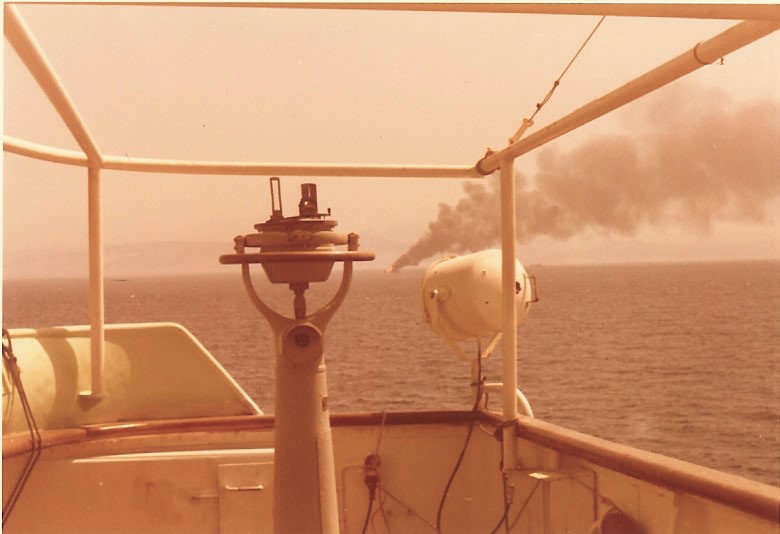
A view from the Samson [Oil Tanker] of the burning production tower in Abu Rudeis that was hit by an Israeli ‘Hawk’ missile
 Yackov's English Stories
Leave a comment