
March 2022
For many years, I hadn’t traveled on public transportation in Israel. On my most recent trip, due to personal limitations and the collective wisdom about traffic congestion and driving culture on the roads, I decided to try traveling solely by public transport. I had a Rav-Kav card at my disposal, which I believe deserves an “invention of the century” award.
The bus service requires significant improvement, but the train service is already nearing maturity, and I thoroughly enjoyed using it. As a tourist not pressed for time, sitting on a forward-moving seat amidst the hustle and bustle of pedestrians and cars, while a poor driver handles all the troubles, is a luxury that can’t be measured in money.
Traveling by bus is enjoyable and provides an opportunity to get to know the people we live among. With masks covering faces (Covid), less of the face is visible, leaving room for imagination. The voices are muffled, and only eye expressions reveal the life stories of people of all ages, brought together by fate in a big, shaking, swaying box that occasionally lurches forward—or even backward. We’re all part of the same dance, moving in the same direction, at the same pace, without music.
Here and there, you spot someone determined to ride without a Rav-Kav. He stands and moves between the front and back doors at every stop, ready to exit if a ticket inspector boards. Or there’s the woman who covers the validation machine with her coat while tapping her card so no one sees the red light indicating that there isn’t even a cent on it. Then there are those (usually women) who keep their card in a small bag hung on their chest and, to bring it close to the machine, press their chest against it as if undergoing a mammogram—nothing more needed to amuse the dirty old man sitting nearby.
For any observer, the experience offers small and large moments—sometimes turning into full-blown comedy for tourists like me, or a tragedy for passengers who have no other travel option.
On one ride, on bus line 65 from Savidor train station toward Sheeba Medical Center, I noticed as soon as I boarded that this trip would be different. The driver was religious, looked Chabad, and wasn’t wearing a mask (a rare sight for the season). He didn’t activate the announcement system that states the next stop, as that system also frequently repeats, annoyingly: “Excuse me? Mask! There’s no room for COVID-19 on this bus!” — quite irritating for those who don’t believe in it.
The ride dragged on slowly through a sea of buses, private cars, vans, and a swarm of scooters filling every gap — a kind of Ramat Gan smorgasbord in the late afternoon. Occasionally the door opened and closed, at stops or not, and passersby hurled questions at the driver like he was the mayor. The driver responded by shouting, as everything around was happening in shouts. In fact, the whole country operates by shouting.
Once I got into the rhythm of the ride, the monotonous noise reminded me of nights I slept on a ship next to a generator, and I dozed off lightly. Suddenly I woke up due to an unusual noise. The bus was stopped on Jordan Street, not at a stop. The driver had leapt off, and passengers began yelling at him to come back. From the street, he shouted there was nowhere to go — ahead was a massive jam, not even a meter of movement. After a while, cars began to bypass us, inching forward, and the passengers, agitated, yelled at the driver to return and move on like the others. Eventually, the driver gave in, and we slowly entered the jaws of the traffic jam.
I remembered the generous hummus portion I devoured at the Blue Bus restaurant in Pardes Hanna and knew I wouldn’t die of hunger on this trip.
The passengers: “Driver! Why is there a jam?”
The driver: “The Jerusalem Faction is blocking Geha Road in several spots.”
One woman, in a loud voice: “Driver! Why are they blocking the road?”
Driver: “I don’t know.”
The woman, not missing a beat: “You should know! You’re religious.” Then she added, “They should break their bones! Where’s the police?”
While her shout lingered in the air, I was dying of laughter, but no one around me was laughing.
Later, we stopped behind a delivery truck and waited for it to move. The jam seemed endless. Some cars began overtaking us, so the driver decided to do the same. As we were side by side with the truck, we saw the truck driver returning with a sandwich. He shouted that he’d been in the jam for four hours and hadn’t eaten. Our driver shouted back that we hadn’t eaten for four hours either, and it was rude of him.
Outside, darkness had fallen, and a feeling of helplessness settled in the bus. Phone batteries died, and passengers complained there were no charging ports, meaning they couldn’t contact worried family members. The driver promised to pass the complaint to Dan (the bus company), along with a recommendation to build “traffic jam buses” with phone chargers and restrooms.
At this point, I realized the hummus I had enjoyed was starting to have an effect, and for the public’s sake, this trip should end soon. Curse that Jerusalem Faction.
Time passed, and we were still on the same street. I approached the driver and politely asked, “Would it be wise to get off here and walk to the stop at the Ramat Efal entrance?”
He looked at me and asked, “Do you really think you’re still fit?”
I got the message and returned to my seat.
At Aluf Sadeh, a girl approached the driver and asked, “When will we get to the train station?”
It seemed at this point the driver completely lost it. He shouted, even though she stood right next to him:
“The train?! That’s on the other side—we’re headed to the hospital!”
By now, I was hysterical with laughter. I was gasping for air, yanked off my mask, and took a deep breath. For a moment, I felt color return to my face before putting the mask back on.
The embarrassed passenger: “Why are you yelling at me? I’m from Haifa.”
I was on the verge of passing out.
Driver: “You’ve been sitting in this jam for two hours. You should’ve taken line 65 on the other side of the street back when it was still clear. Now the jam’s in all directions.”
We finally reached Geha, and the driver suggested she get off at the terminal, where she might catch a bus to Haifa once the road opened. She asked to get off but requested that the driver wait while she fetched the bag she left at the back. And so, the bus waited, while other vehicles passed us by.
Before getting off, I stood near the front door and looked at the driver. He looked pale, his beard disheveled, his tzitzit twisted beneath his white shirt — he resembled someone I once knew who fell into the Hudson and was pulled back to shore.
On my way out, I thanked him for the ride and added that I didn’t envy him one bit.
We spent three hours on a route that usually takes half an hour. The passengers were late and frustrated. I had an experience only a few public transport users ever get to witness — a raw, unpolished human theater in its full glory.
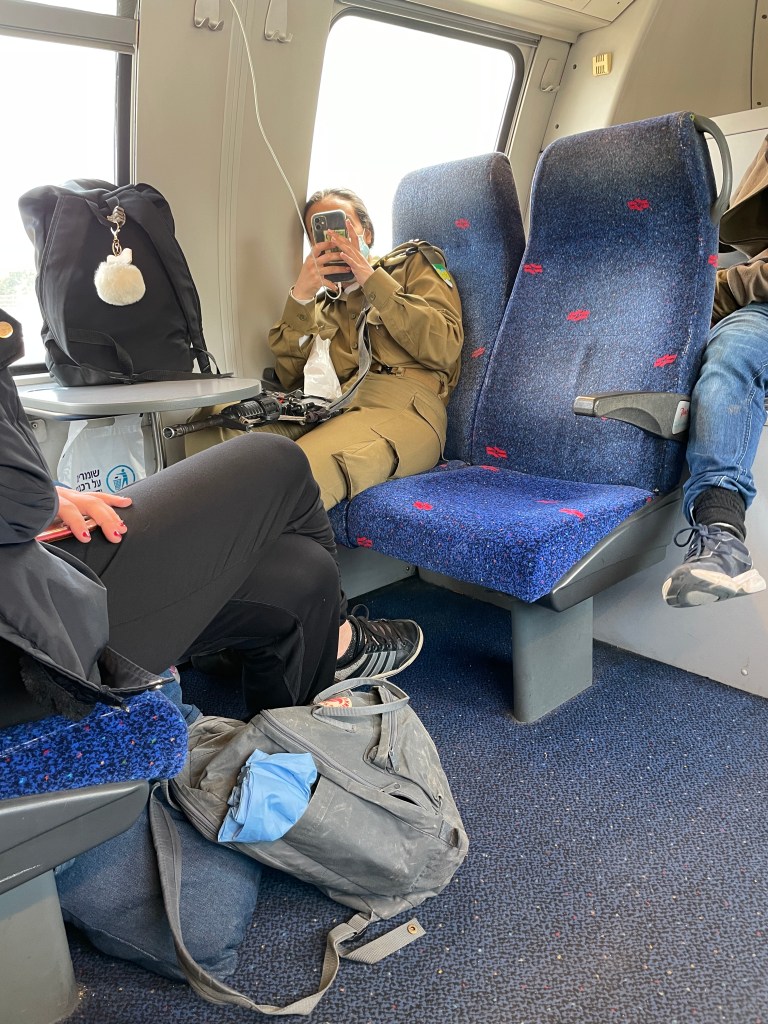
Explanation of the attached photo:
A rifle on public transportation in Israel is routine. In the U.S., the Woke culture dominates, and many people are scared of the American flag — so a rifle on a train would probably cause them a nervous breakdown and permanent trauma. A rifle barrel pointed toward me — toward my groin — during a continuous train ride is not a positive feeling. I moved to another seat and photographed the officer, whose weapon wasn’t just on her — the barrel was pointed between the legs of the woman who took my seat. Just an ordinary day in Israel.
 Yackov's English Stories
Leave a comment